Caraterize a função inversa
Funções exponenciais e logarítmicas: Infinito 12 A - Parte 2 Pág. 55 Ex. 28
Caraterize a função inversa de cada uma das funções definidas por:
- $f:x\to 1+{{2}^{x}}$
- $g:x\to {{\log }_{2}}(3-5x)$
- $h:x\to 4-3{{e}^{-x+2}}$
- $j:x\to 4-\ln (1-2x)$
-
$f:x\to 1+{{2}^{x}}$
Comecemos por determinar o domínio da função:
$$\begin{array}{*{35}{l}}
{{D}_{f}}=D{{‘}_{{{f}^{-1}}}} & = & \left\{ x\in \mathbb{R}:x\in \mathbb{R} \right\} \\
{} & = & \mathbb{R} \\
\end{array}$$
Ora, $$\begin{array}{*{35}{l}}
y=1+{{2}^{x}} & \Leftrightarrow & {{2}^{x}}=y-1 \\
{} & \Leftrightarrow & x={{\log }_{2}}(y-1) \\
\end{array}$$
Logo, o domínio da função inversa é: \[\begin{array}{*{35}{l}}
{{D}_{{{f}^{-1}}}}=D{{‘}_{f}} & = & \left\{ x\in \mathbb{R}:x-1>0 \right\} \\
{} & = & \left] 1,+\infty \right[ \\
\end{array}\]
Portanto, a função inversa é caraterizada por: \[\begin{array}{*{35}{l}}
{{f}^{-1}}: & \left] 1,+\infty \right[\to \mathbb{R} \\
{} & x\to {{\log }_{2}}(x-1) \\
\end{array}\]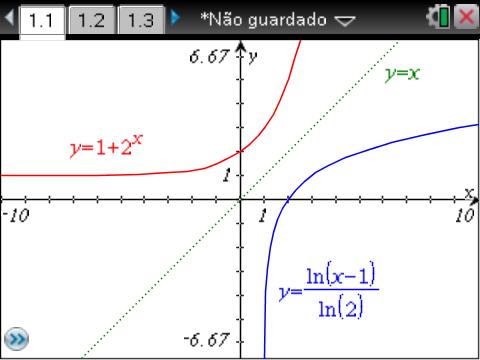
-
$g:x\to {{\log }_{2}}(3-5x)$
Comecemos por determinar o domínio da função:
\[\begin{array}{*{35}{l}}
{{D}_{g}}=D{{‘}_{{{g}^{-1}}}} & = & \left\{ x\in \mathbb{R}:3-5x>0 \right\} \\
{} & = & \left\{ x\in \mathbb{R}:x<\frac{3}{5} \right\} \\
{} & = & \left] -\infty ,\frac{3}{5} \right[ \\
\end{array}\]
Ora, \[\begin{array}{*{35}{l}}
y={{\log }_{2}}(3-5x) & \Leftrightarrow & 3-5x={{2}^{y}} \\
{} & \Leftrightarrow & x=\frac{3-{{2}^{y}}}{5} \\
\end{array}\]
Logo, o domínio da função inversa é: \[\begin{array}{*{35}{l}}
{{D}_{{{g}^{-1}}}}=D{{‘}_{g}} & = & \left\{ x\in \mathbb{R}:x\in \mathbb{R} \right\} \\
{} & = & \mathbb{R} \\
\end{array}\]
Portanto, a função inversa é caraterizada por: \[\begin{array}{*{35}{l}}
{{g}^{-1}}: & \mathbb{R}\to \left] -\infty ,\frac{3}{5} \right[ \\
{} & x\to \frac{3-{{2}^{x}}}{5} \\
\end{array}\]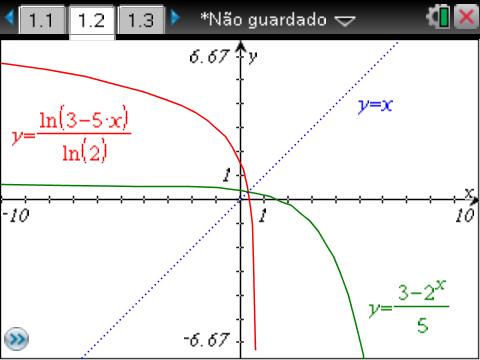
-
$h:x\to 4-3{{e}^{-x+2}}$
Comecemos por determinar o domínio da função:
\[\begin{array}{*{35}{l}}
{{D}_{h}}=D{{‘}_{{{h}^{-1}}}} & = & \left\{ x\in \mathbb{R}:(-x+2)\in \mathbb{R} \right\} \\
{} & = & \mathbb{R} \\
\end{array}\]
Ora, \[\begin{array}{*{35}{l}}
y=4-3{{e}^{-x+2}} & \Leftrightarrow & {{e}^{-x+2}}=\frac{4-y}{3} \\
{} & \Leftrightarrow & -x+2=\ln \left( \frac{4-y}{3} \right) \\
{} & \Leftrightarrow & x=2-\ln \left( \frac{4-y}{3} \right) \\
\end{array}\]
Logo, o domínio da função inversa é: \[\begin{array}{*{35}{l}}
{{D}_{{{h}^{-1}}}}=D{{‘}_{h}} & = & \left\{ x\in \mathbb{R}:\frac{4-x}{3}>0 \right\} \\
{} & = & \left] -\infty ,4 \right[ \\
\end{array}\]
Portanto, a função inversa é caraterizada por: \[\begin{array}{*{35}{l}}
{{h}^{-1}}: & \left] -\infty ,4 \right[\to \mathbb{R} \\
{} & x\to 2-\ln \left( \frac{4-x}{3} \right) \\
\end{array}\]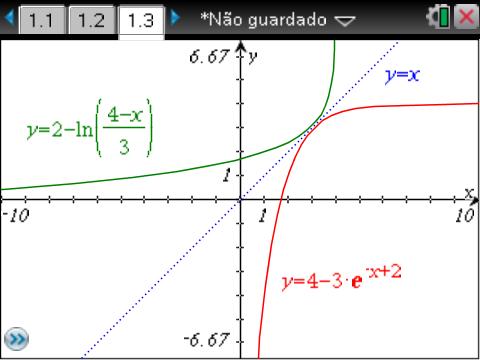
-
$j:x\to 4-\ln (1-2x)$
Comecemos por determinar o domínio da função:
\[\begin{array}{*{35}{l}}
{{D}_{j}}=D{{‘}_{{{j}^{-1}}}} & = & \left\{ x\in \mathbb{R}:1-2x>0 \right\} \\
{} & = & \left\{ x\in \mathbb{R}:x<\frac{1}{2} \right\} \\
{} & = & \left] -\infty ,\frac{1}{2} \right[ \\
\end{array}\]
Ora, \[\begin{array}{*{35}{l}}
y=4-\ln (1-2x) & \Leftrightarrow & \ln (1-2x)=4-y \\
{} & \Leftrightarrow & 1-2x={{e}^{4-y}} \\
{} & \Leftrightarrow & x=\frac{1-{{e}^{4-y}}}{2} \\
\end{array}\]
Logo, o domínio da função inversa é: \[\begin{array}{*{35}{l}}
{{D}_{{{j}^{-1}}}}=D{{‘}_{j}} & = & \left\{ x\in \mathbb{R}:(4-x)\in \mathbb{R} \right\} \\
{} & = & \mathbb{R} \\
\end{array}\]
Portanto, a função inversa é caraterizada por: \[\begin{array}{*{35}{l}}
{{j}^{-1}}: & \mathbb{R}\to \left] -\infty ,\frac{1}{2} \right[ \\
{} & x\to \frac{1-{{e}^{4-x}}}{2} \\
\end{array}\]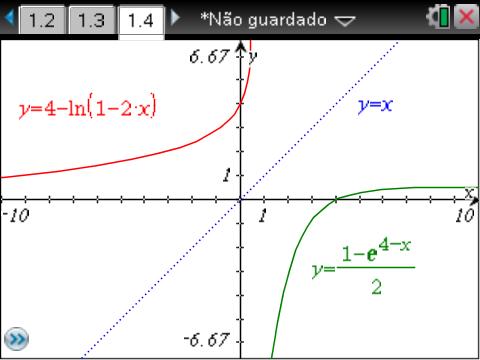






![O quadrilátero [ABCD] está dividido em dois triângulos retângulos](https://www.acasinhadamatematica.pt/wp-content/uploads/2018/03/9V2Pag056-9a-720x340.png)