A inversa de uma função
Função inversa: Aleph 11 - Volume 2 Pág. 174 Ex. 15
A função $f$ tem domínio $\left[ {0, + \infty } \right[$ e é definida por $f\left( x \right) = 4{x^2} + 1$.
- Esboce o gráfico de $f$ e indique o contradomínio da função.
- Explique porque existe inversa de $f$ e determine uma expressão para ${f^{ – 1}}\left( x \right)$.
- Sabendo que $g$ é outra função cujo domínio é $\left[ {0, + \infty } \right[$ e é definida por $g\left( x \right) = \sqrt {x + 6} $, resolva a desigualdade $f\left( {g\left( x \right)} \right) \geqslant f\left( x \right)$.
 De acordo com a representação gráfica apresentada ao lado, o contradomínio da função $f$ é $D{‘_f} = \left[ {1, + \infty } \right[$.
- Como a função $f$ é injetiva, então admite inversa, sendo ${D_{{f^{ – 1}}}} = D{‘_f} = \left[ {1, + \infty } \right[$ e $D{‘_{{f^{ – 1}}}} = {D_f} = \left[ {0, + \infty } \right[$.
\[\begin{array}{*{20}{l}}
{y = 4{x^2} + 1}& \Leftrightarrow &{{x^2} = \frac{{y – 1}}{4}} \\
{}& \Leftrightarrow &{\begin{array}{*{20}{l}}
{x = – \sqrt {\frac{{y – 1}}{4}} }& \vee &{x = \sqrt {\frac{{y – 1}}{4}} }
\end{array}} \\
{}& \Leftrightarrow &{\begin{array}{*{20}{l}}
{x = – \frac{{\sqrt {y – 1} }}{2}}& \vee &{x = \frac{{\sqrt {y – 1} }}{2}}
\end{array}}
\end{array}\]Como $D{‘_{{f^{ – 1}}}} = {D_f} = \left[ {0, + \infty } \right[$, então ${f^{ – 1}}\left( x \right) = \frac{{\sqrt {x – 1} }}{2}$.
Portanto, a função inversa de $f$ é: \[\begin{array}{*{20}{l}}
{{f^{ – 1}}:}&{\left[ {1, + \infty } \right[ \to \left[ {0, + \infty } \right[} \\
{}&{x \to \frac{{\sqrt {x – 1} }}{2}}
\end{array}\]Nota: A inversa da função de domínio $\left] { – \infty ,0} \right]$ e definida por $h\left( x \right) = 4{x^2} + 1$ é: \[\begin{array}{*{20}{l}}
{{h^{ – 1}}:}&{\left[ {1, + \infty } \right[ \to \left] { – \infty ,0} \right]} \\
{}&{x \to – \frac{{\sqrt {x – 1} }}{2}}
\end{array}\] - Convém notar que o domínio da função $f \circ g$ é: \[{D_{f \circ g}} = \left\{ {x \in \mathbb{R}:x \in {D_g} \wedge g\left( x \right) \in {D_f}} \right\} = \left\{ {x \in \mathbb{R}:x \in \mathbb{R}_0^ + \wedge \sqrt {x + 6} \in \mathbb{R}_0^ + } \right\} = \mathbb{R}_0^ + \]
Resolvendo a condição, vem: \[\begin{array}{*{20}{l}}
{f\left( {g\left( x \right)} \right) \geqslant f\left( x \right)}& \Leftrightarrow &{\begin{array}{*{20}{l}}
{4{{\left( {\sqrt {x + 6} } \right)}^2} + 1 \geqslant 4{x^2} + 1}& \wedge &{x \in \mathbb{R}_0^ + }
\end{array}} \\
{}& \Leftrightarrow &{4x + 24\begin{array}{*{20}{l}}
{ + 1 \geqslant 4{x^2} + 1}& \wedge &{x \in \mathbb{R}_0^ + }
\end{array}} \\
{}& \Leftrightarrow &{\begin{array}{*{20}{l}}
{{x^2} – x – 6 \leqslant 0}& \wedge &{x \in \mathbb{R}_0^ + }
\end{array}} \\
{}& \Leftrightarrow &{\begin{array}{*{20}{l}}
{\left( {x + 2} \right)\left( {x – 3} \right) \leqslant 0}& \wedge &{x \in \mathbb{R}_0^ + }
\end{array}} \\
{}& \Leftrightarrow &{\begin{array}{*{20}{l}}
{x \in \left[ { – 2,3} \right]}& \wedge &{x \in \mathbb{R}_0^ + }
\end{array}} \\
{}& \Leftrightarrow &{x \in \left[ {0,3} \right]}
\end{array}\]Situação que também se pode verificar no gráfico acima.
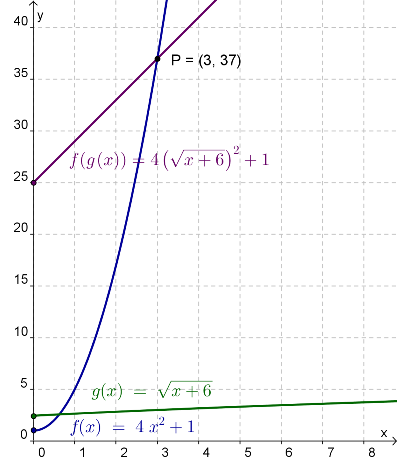 De acordo com a representação gráfica apresentada ao lado, o contradomínio da função $f$ é $D{‘_f} = \left[ {1, + \infty } \right[$.