As raízes quartas de $1$
Números complexos: Infinito 12 A - Parte 3 Pág. 143 Ex. 60
Determine as raízes quartas de $1$ e represente os seus afixos do diagrama de Argand.
Como $z = 1 = \operatorname{cis} \left( 0 \right)$, então as suas raízes quartas são:
$$\begin{array}{*{20}{l}}
{k = 0:}&{{w_0} = \operatorname{cis} \left( {\frac{0}{4}} \right) = \operatorname{cis} \left( 0 \right) = 1} \\
{k = 1:}&{{w_1} = \operatorname{cis} \left( {\frac{0}{4} + \frac{{2\pi }}{4}} \right) = \operatorname{cis} \left( {\frac{\pi }{2}} \right) = i} \\
{k = 2:}&{{w_2} = \operatorname{cis} \left( {\frac{0}{4} + \frac{{4\pi }}{4}} \right) = \operatorname{cis} \left( \pi \right) = – 1} \\
{k = 3:}&{{w_3} = \operatorname{cis} \left( {\frac{0}{4} + \frac{{6\pi }}{4}} \right) = \operatorname{cis} \left( {\frac{{3\pi }}{2}} \right) = – i}
\end{array}$$
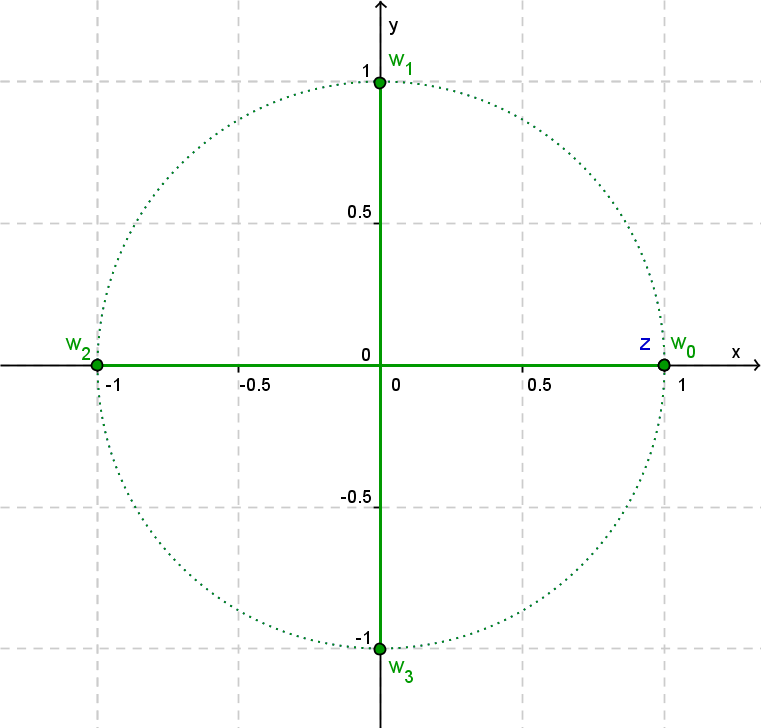
As raízes quartas de $z = 1$.