Tarefa 4 – Valores aproximados de números reais
Os números reais: Matematicamente Falando 9 - Parte 1 Pág. 23
 Escreve uma aproximação de \(\pi \) com erro inferior a \(0,01\).
Justifica a tua resposta.- Considera que \(5\) é uma aproximação de um número real \(x\) com erro inferior a \(0,3\) e que \( – 2\) é uma aproximação de um número real \(y\) com erro inferior a \(0,1\).

- Calcula uma aproximação de \(x + y\).
O erro cometido é inferior a quanto? - Qual é o erro máximo que se comete ao aproximar \(x \times y\) por \(5 \times \left( { – 2} \right) = – 10\)?
A definição
Dado um número \(x\) e um número positivo \(r\), o número \(x’\) é uma aproximação de \(x\) com erro inferior a \(r\) quando \(x’ \in \left] {x – r,\;x + r} \right[\) , ou seja, quando \({x – r < x’ < x + r}\).
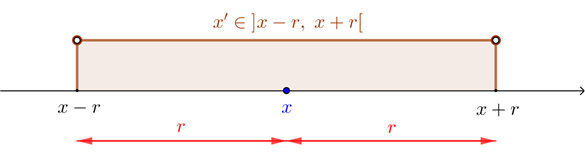
Com efeito, \(\begin{array}{*{20}{c}}{x’ \in \left] {x – r,\;x + r} \right[}& \Leftrightarrow &{x – r < x’ < x + r}\end{array}\), conforme se pode concluir da representação gráfica acima.
Mas, a expressão anterior pode ser escrita de outra forma equivalente:
\[\begin{array}{*{20}{l}}{x’ \in \left] {x – r,\;x + r} \right[}& \Leftrightarrow &{x – r < x’ < x + r}\\{}& \Leftrightarrow &{\begin{array}{*{20}{c}}{x – r < x’}& \wedge &{x’ < x + r}\end{array}}\\{}& \Leftrightarrow &{\begin{array}{*{20}{c}}{x – r + r < x’ + r}& \wedge &{x’ – r < x + r – r}&{{\rm{(Porquê ?)}}}\end{array}}\\{}& \Leftrightarrow &{\begin{array}{*{20}{c}}{x < x’ + r}& \wedge &{x’ – r < x}\end{array}}\\{}& \Leftrightarrow &{x’ – r < x < x’ + r}\\{}& \Leftrightarrow &{x \in \left] {x’ – r,\;x’ + r} \right[}\end{array}\]
Assim, a definição dada acima pode também ser enunciada do modo seguinte.
Uma definição equivalente
Um número \(x’\) é uma aproximação de um número \(x\) com erro inferior a \(r\) \(\left( {r > 0} \right)\) quando e apenas quando \(x’ – r < x < x’ + r\), isto é, quando e apenas quando \(x \in \left] {x’ – r,\;x’ + r} \right[\).
Relativamente à equivalência obtida acima, convém notar o seguinte:
\[\begin{array}{*{20}{l}}{x’ \in \left] {x – {r_1},\;x + {r_2}} \right[}& \Leftrightarrow &{x – {r_1} < x’ < x + {r_2}}\\{}& \Leftrightarrow &{\begin{array}{*{20}{c}}{x – {r_1} < x’}& \wedge &{x’ < x + {r_2}}\end{array}}\\{}& \Leftrightarrow &{\begin{array}{*{20}{c}}{x – {r_1} + {r_1} < x’ + {r_1}}& \wedge &{x’ – {r_2} < x + {r_2} – {r_2}}&{{\rm{(Porquê ?)}}}\end{array}}\\{}& \Leftrightarrow &{\begin{array}{*{20}{c}}{x < x’ + {r_1}}& \wedge &{x’ – {r_2} < x}\end{array}}\\{}& \Leftrightarrow &{x’ – {r_2} < x < x’ + {r_1}}\\{}& \Leftrightarrow &{x \in \left] {x’ – {r_2},\;x’ + {r_1}} \right[}\end{array}\]
- No caso presente, temos \(x = \pi \) e \(r = 0,001\).
Ora, uma aproximação de \(\pi \) com erro inferior a \(0,001\) é todo o valor \(x’\), tal que \(x’ \in \left] {\pi – 0,001;\;\pi + 0,001} \right[\), ou seja, tal que \(\pi – 0,001 < x’ < \pi + 0,001\).
Portanto, \(3,141\), por exemplo, é uma aproximação de \(\pi \) com erro inferior a \(0,001\).
- De acordo com os dados e em conformidade com a primeira definição da secção anterior, temos:
- \(x’ = 5\), \(x = ?\) e \({r_1} = 0,3\). Ou seja: \(\begin{array}{*{20}{c}}{5 \in \left] {x – 0,3;\;x + 0,3} \right[}& \Leftrightarrow &{x – 0,3 < 5 < x + 0,3}\end{array}\)
- \(y’ = – 2\), \(y = ?\) e \({r_2} = 0,1\). Ou seja: \(\begin{array}{*{20}{c}}{ – 2 \in \left] {y – 0,1;\;y + 0,1} \right[}& \Leftrightarrow &{y – 0,1 < – 2 < y + 0,1}\end{array}\)
No entanto, estas relações podem ser escritas de outro modo equivalente, explicitando-as em termos de \(x\) e de \(y\). Isso pode ser feito por aplicação direta da segunda definição da secção anterior ou por dedução a partir das relações escritas acima, que é o que se vai apresentar:
\[\begin{array}{*{20}{l}}{5 \in \left] {x – 0,3;\;x + 0,3} \right[}& \Leftrightarrow &{x – 0,3 < 5 < x + 0,3}\\{}& \Leftrightarrow &{\begin{array}{*{20}{c}}{x – 0,3 < 5}& \wedge &{5 < x + 0,3}\end{array}}\\{}& \Leftrightarrow &{\begin{array}{*{20}{c}}{x – 0,3 + 0,3 < 5 + 0,3}& \wedge &{5 – 0,3 < x + 0,3 – 0,3}\end{array}}\\{}& \Leftrightarrow &{\begin{array}{*{20}{c}}{x < 5,3}& \wedge &{4,7 < x}\end{array}}\\{}& \Leftrightarrow &{4,7 < x < 5,3}\end{array}\]
\[\begin{array}{*{20}{l}}{ – 2 \in \left] {y – 0,1;\;y + 0,1} \right[}& \Leftrightarrow &{y – 0,1 < – 2 < y + 0,1}\\{}& \Leftrightarrow &{\begin{array}{*{20}{c}}{y – 0,1 < – 2}& \wedge &{ – 2 < y + 0,1}\end{array}}\\{}& \Leftrightarrow &{\begin{array}{*{20}{c}}{y – 0,1 + 0,1 < – 2 + 0,1}& \wedge &{ – 2 – 0,1 < y + 0,1 – 0,1}\end{array}}\\{}& \Leftrightarrow &{\begin{array}{*{20}{c}}{y < – 1,9}& \wedge &{ – 2,1 < y}\end{array}}\\{}& \Leftrightarrow &{ – 2,1 < y < – 1,9}\end{array}\]
-
ALTERNATIVA 1
Como \(4,7 < x < 5,3\) e \( – 2,1 < y < – 1,9\), começando por utilizar a propriedade da pág. 13 do manual vem:
\[\begin{array}{*{20}{l}}{4,7 + \left( { – 2,1} \right) < x + y < 5,3 + \left( { – 1,9} \right)}& \Leftrightarrow &{2,6 < x + y < 3,4}\\{}& \Leftrightarrow &{\left( {x + y} \right) \in \left] {2,6;\;3,4} \right[}\\{}& \Leftrightarrow &{\left( {x + y} \right) \in \left] {3 – 0,4;\;3 + 0,4} \right[}\\{}& \Leftrightarrow &{\begin{array}{*{20}{c}}{3 \in \left] {\left( {x + y} \right) – 0,4;\;\left( {x + y} \right) + 0,4} \right[}&{{\rm{(Porquê ?)}}}&{{\rm{(Def}}{\rm{. 2)}}}\end{array}}\end{array}\]
Deste modo, conclui-se que \(3 = 5 + \left( { – 2} \right)\) é uma aproximação de \(x + y\) com erro inferior a \(0,4 = 0,3 + 0,1\).
ALTERNATIVA 2
Como \(5 – 0,3 < x < 5 + 0,3\) e \( – 2 – 0,1 < y < – 2 + 0,1\), começando por utilizar a propriedade da pág. 13 do manual vem:
\[\begin{array}{*{20}{l}}{5 – 0,3 + \left( { – 2 – 0,1} \right) < x + y < 5 + 0,3 + \left( { – 2 + 0,1} \right)}& \Leftrightarrow &{3 – \left( {0,3 + 0,1} \right) < x + y < 3 + \left( {0,3 + 0,1} \right)}\\{}& \Leftrightarrow &{\left( {x + y} \right) \in \left] {3 – 0,4;\;3 + 0,4} \right[}\\{}& \Leftrightarrow &{\begin{array}{*{20}{c}}{3 \in \left] {\left( {x + y} \right) – 0,4;\;\left( {x + y} \right) + 0,4} \right[}&{{\rm{(Porquê ?)}}}&{{\rm{(Def}}{\rm{. 2)}}}\end{array}}\end{array}\]
Deste modo, conclui-se que \(3 = 5 + \left( { – 2} \right)\) é uma aproximação de \(x + y\) com erro inferior a \(0,4 = 0,3 + 0,1\).
ALTERNATIVA 3
Analogamente, \(\begin{array}{*{20}{l}}{5 – 0,3 + \left( { – 2 – 0,1} \right) < x + y < 5 + 0,3 + \left( { – 2 + 0,1} \right)}& \Leftrightarrow &{3 – \left( {0,3 + 0,1} \right) < x + y < 3 + \left( {0,3 + 0,1} \right)}\end{array}\).
Logo, \(3 = 5 + \left( { – 2} \right)\) é uma aproximação de \(x + y\) com erro inferior a \(0,4 = 0,3 + 0,1\). (Porquê?) (Def. 2)
-
ALTERNATIVA 1
Já verificamos anteriormente que \(4,7 < x < 5,3\) e \( – 2,1 < y < – 1,9\).
Tendo em conta que \(\begin{array}{*{20}{c}}{ – 2,1 < y < – 1,9}& \Leftrightarrow &{1,9 < – y < 2,1}\end{array}\) e utilizando a propriedade da pág. 13 do manual vem:
\[\begin{array}{*{20}{l}}{4,7 \times 1,9 < – x \times y < 5,3 \times 2,1}& \Leftrightarrow &{8,93 < – x \times y < 11,13}\\{}& \Leftrightarrow &{ – 11,13 < x \times y < – 8,93}\\{}& \Leftrightarrow &{\left( {x \times y} \right) \in \left] { – 11,13;\; – 8,93} \right[}\\{}& \Leftrightarrow &{\left( {x \times y} \right) \in \left] { – 10 – 1,13;\; – 10 + 1,07} \right[}\\{}& \Leftrightarrow &{\begin{array}{*{20}{c}}{ – 10 \in \left] {\left( {x \times y} \right) – 1,07;\;\left( {x \times y} \right) + 1,13} \right[}&{{\rm{(Nota**)}}}\end{array}}\end{array}\]Deste modo, conclui-se que \( – 10 = 5 \times \left( { – 2} \right)\) é uma aproximação de \(x \times y\) com erro máximo inferior a \(1,13\).
Cálculo: \(1,13 = 5 \times 0,1 + 2 \times 0,3 + 0,3 \times 0,1\). (Ver resolução da Alternativa 2)ALTERNATIVA 2
Já verificamos anteriormente que \(5 – 0,3 < x < 5 + 0,3\) e \( – 2, – 0,1 < y < – 2 + 0,1\).
Tendo em conta que \(\begin{array}{*{20}{c}}{ – 2 – 0,1 < y < – 2 + 0,1}& \Leftrightarrow &{2 – 0,1 < – y < 2 + 0,1}\end{array}\) e utilizando a propriedade da pág. 13 do manual vem:
\[\begin{array}{*{20}{l}}{\left( {5 – 0,3} \right) \times \left( {2 – 0,1} \right) < – x \times y < \left( {5 + 0,3} \right) \times \left( {2 + 0,1} \right)}& \Leftrightarrow &{10 – 5 \times 0,1 – 2 \times 0,3 + 0,3 \times 0,1 < – x \times y < 10 + 5 \times 0,1 + 2 \times 0,3 + 0,3 \times 0,1}\\{}& \Leftrightarrow &{ – 10 – 5 \times 0,1 – 2 \times 0,3 – 0,3 \times 0,1 < x \times y < – 10 + 5 \times 0,1 + 2 \times 0,3 – 0,3 \times 0,1}\\{}& \Leftrightarrow &{\left( {x \times y} \right) \in \left] { – 10 – 5 \times 0,1 – 2 \times 0,3 – 0,3 \times 0,1;\; – 10 + 5 \times 0,1 + 2 \times 0,3 – 0,3 \times 0,1} \right[}\\{}& \Leftrightarrow &{\begin{array}{*{20}{c}}{ – 10 \in \left] {\left( {x \times y} \right) – 5 \times 0,1 – 2 \times 0,3 + 0,3 \times 0,1;\;\left( {x \times y} \right) + 5 \times 0,1 + 2 \times 0,3 + 0,3 \times 0,1} \right[}\end{array}}\\{}& \Leftrightarrow &{ – 10 \in \left] {\left( {x \times y} \right) – 1,07;\;\left( {x \times y} \right) + 1,13} \right[}\end{array}\]
Deste modo, conclui-se que \( – 10 = 5 \times \left( { – 2} \right)\) é uma aproximação de \(x \times y\) com erro máximo inferior a \(1,13\).
Cálculo: \(1,13 = 5 \times 0,1 + 2 \times 0,3 + 0,3 \times 0,1\).Nota**:
\[\begin{array}{*{20}{l}}{x’ \in \left] {x – {r_1},\;x + {r_2}} \right[}& \Leftrightarrow &{x – {r_1} < x’ < x + {r_2}}\\{}& \Leftrightarrow &{\begin{array}{*{20}{c}}{x – {r_1} < x’}& \wedge &{x’ < x + {r_2}}\end{array}}\\{}& \Leftrightarrow &{\begin{array}{*{20}{c}}{x – {r_1} + {r_1} < x’ + {r_1}}& \wedge &{x’ – {r_2} < x + {r_2} – {r_2}}&{{\rm{(Porquê ?)}}}\end{array}}\\{}& \Leftrightarrow &{\begin{array}{*{20}{c}}{x < x’ + {r_1}}& \wedge &{x’ – {r_2} < x}\end{array}}\\{}& \Leftrightarrow &{x’ – {r_2} < x < x’ + {r_1}}\\{}& \Leftrightarrow &{x \in \left] {x’ – {r_2},\;x’ + {r_1}} \right[}\end{array}\]