Daily Archive: Março 2, 2012

0

Calcule os seguintes limites, se existirem

Teoria de limites: Infinito 12 A - Parte 2 Pág. 206 Ex. 20

Enunciado

Calcule os seguintes limites, se existirem:

  1. ${\mathop {\lim }\limits_{x \to 3} \frac{{{x^2} – 4x + 3}}{{x + 1}}}$
    ­
  2. ${\mathop {\lim }\limits_{x \to  – 1} \frac{x}{{{{\left( {x + 1} \right)}^2}}}}$
    ­
  3. ${\mathop {\lim }\limits_{t \to  – \infty } \left( {2{t^3} + {t^2} + 1} \right)}$
    ­
  4. ${\mathop {\lim }\limits_{m \to  – 1} \frac{{{m^3} + 1}}{{m + 1}}}$
    ­
  5. ${\mathop {\lim }\limits_{r \to 2} \frac{{{r^4} – 16}}{{r – 2}}}$
    ­
  6. $\mathop {\lim }\limits_{x \to 3} \frac{{\left| { –
Ler mais
0

Limites laterais da função $f$

Teoria de limites: Infinito 12 A - Parte 2 Pág. 204 Ex. 14

Enunciado

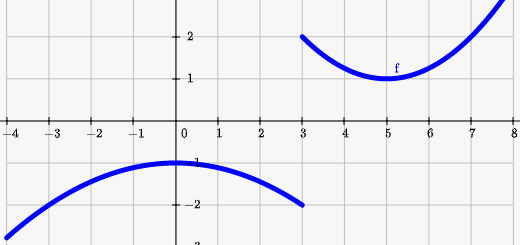
Sabe-se que $f({u_n}) = 2$ e $f({v_n}) =  – 2$ para todas as sucessões $({u_n})$ e $({v_n})$ nas condições seguintes:

  • $\begin{array}{*{20}{l}}   {({u_n} \in {D_f}}& \wedge &{{u_n} > 3,}&{\forall n \in \mathbb{N})}& \wedge &{{u_n} \to 3} \end{array}$
  • $\begin{array}{*{20}{l}}   {({v_n} \in {D_f}}& \wedge &{{v_n} < 3,}&{\forall n \in \mathbb{N})}& \wedge &{{v_n} \to 3} \end{array}$

Conclua, caso seja possível, quanto à existência e ao valor:

  1. dos limites laterais da função $f$ no ponto de abcissa 3;
  2. do limite da função
Ler mais