Defina sem usar o símbolo de módulo
Mais funções: Aleph 11 - Volume 2 Pág. 116 Ex. 5
Defina, sem usar o símbolo de módulo, e represente graficamente, cada uma das seguintes funções:
- $f(x) = \left| {x – 1} \right| + 2$
- $g(x) = – \left| {3{x^2} – 2x – 1} \right|$
- $h(x) = – \left| {x\left( {x – 2} \right)\left( {x + 1} \right)} \right|$
-

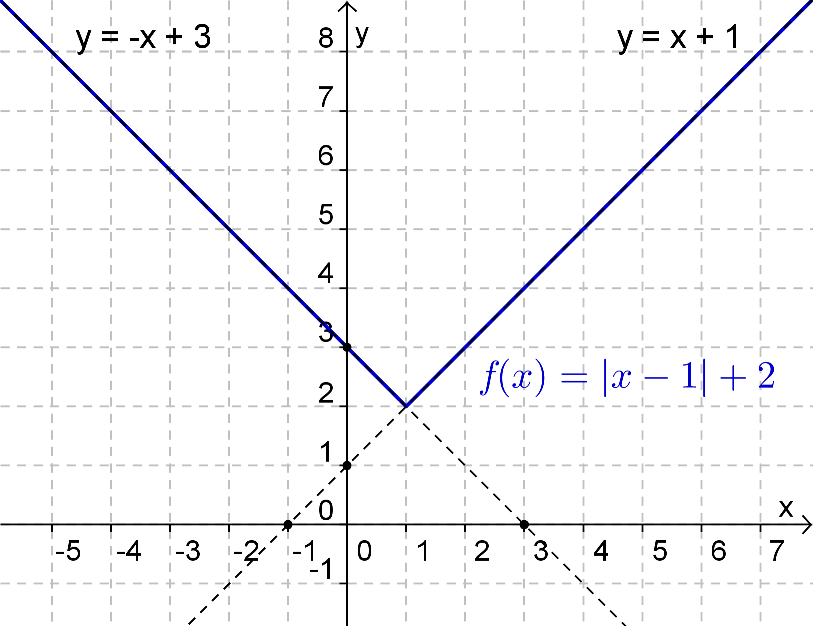
Gráfico de $f$
Tem-se sucessivamente:
\[\begin{array}{*{20}{l}}
{f(x)}& = &{\left| {x – 1} \right| + 2} \\
{}& = &{\left\{ {\begin{array}{*{20}{l}}
{\left( {x – 1} \right) + 2}& \Leftarrow &{x – 1 \geqslant 0} \\
{ – \left( {x – 1} \right) + 2}& \Leftarrow &{x – 1 < 0}
\end{array}} \right.} \\
{}& = &{\left\{ {\begin{array}{*{20}{l}}
{ – x + 3}& \Leftarrow &{x < 1} \\
{x + 1}& \Leftarrow &{x \geqslant 1}
\end{array}} \right.}
\end{array}\]Para a representação gráfica de $f$ recorreu-se aos gráficos das funções auxiliares ${y_1} = – x + 3$ e ${y_2} = x + 1$.
- Comecemos por calcular os zeros da função quadrática $y = 3{x^2} – 2x – 1$:
\[\begin{array}{*{20}{l}}
{3{x^2} – 2x – 1 = 0}& \Leftrightarrow &{x = \frac{{2 \mp \sqrt {4 + 12} }}{6}} \\
{}& \Leftrightarrow &{\begin{array}{*{20}{l}}
{x = – \frac{1}{3}}& \vee &{x = 1}
\end{array}}
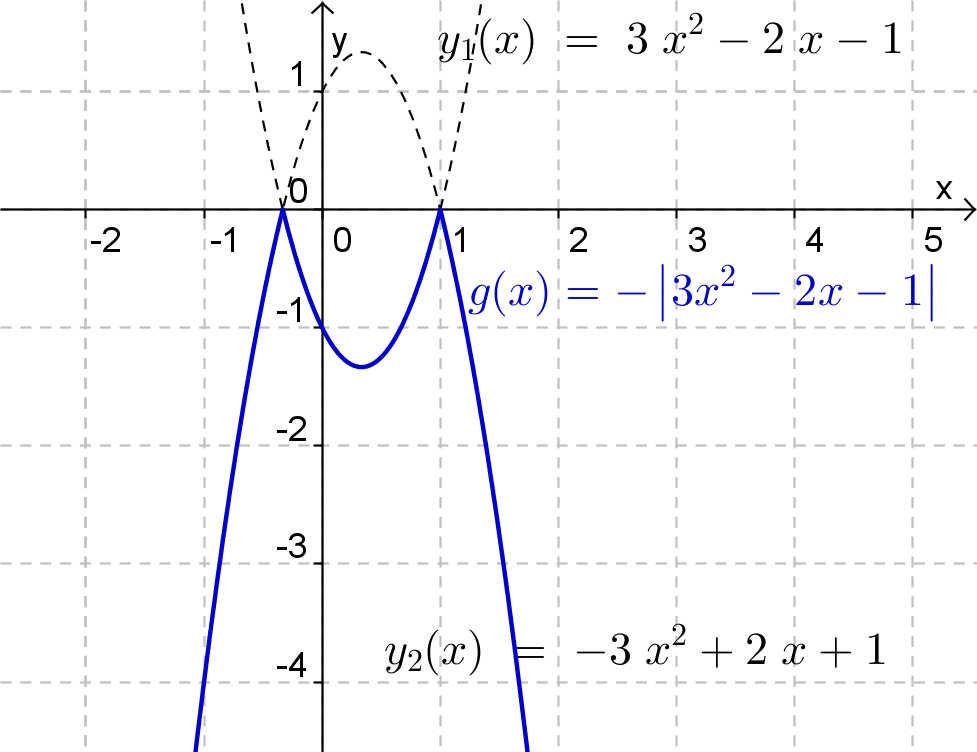
\end{array}\]Gráfico de $g$
Tendo em consideração que o gráfico de $y = 3{x^2} – 2x – 1$ é uma parábola com a concavidade voltada para cima e que interseta o eixo $Ox$ nos pontos de abcissas ${ – \frac{1}{3}}$ e $1$, vem:
\[\begin{array}{*{20}{l}}
{g(x)}& = &{ – \left| {3{x^2} – 2x – 1} \right|} \\
{}& = &{\left\{ {\begin{array}{*{20}{l}}
{ – \left( { – \left( {3{x^2} – 2x – 1} \right)} \right)}& \Leftarrow &{x \in \left] { – \frac{1}{3},1} \right[} \\
{ – \left( {3{x^2} – 2x – 1} \right)}& \Leftarrow &{x \in \left] { – \infty , – \frac{1}{3}} \right] \cup \left[ {1, + \infty } \right[}
\end{array}} \right.} \\
{}& = &{\left\{ {\begin{array}{*{20}{l}}
{3{x^2} – 2x – 1}& \Leftarrow &{x \in \left] { – \frac{1}{3},1} \right[} \\
{ – 3{x^2} + 2x + 1}& \Leftarrow &{x \in \left] { – \infty , – \frac{1}{3}} \right] \cup \left[ {1, + \infty } \right[}
\end{array}} \right.}
\end{array}\]Para a representação gráfica de $g$ recorreu-se aos gráficos das funções auxiliares ${y_1} = 3{x^2} – 2x – 1$ e ${y_2} = – 3{x^2} + 2x + 1$.
-
Comecemos por estudar o sinal da função $y = x\left( {x – 2} \right)\left( {x + 1} \right)$:
\[\begin{array}{*{20}{c}}
x&{ – \infty }&{}&{}&{ – 1}&{}&0&{}&2&{}&{}&{ + \infty } \\
\hline
x&{}& – &{}& – & – &0& + & + &{}& + &{} \\
\hline
{x – 2}&{}& – &{}& – & – & – & – &0&{}& + &{} \\
\hline
{x + 1}&{}& – &{}&0& + & + & + & + &{}& + &{} \\
\hline
y&{}& – &{}&0& + &0& – &0&{}& + &{}
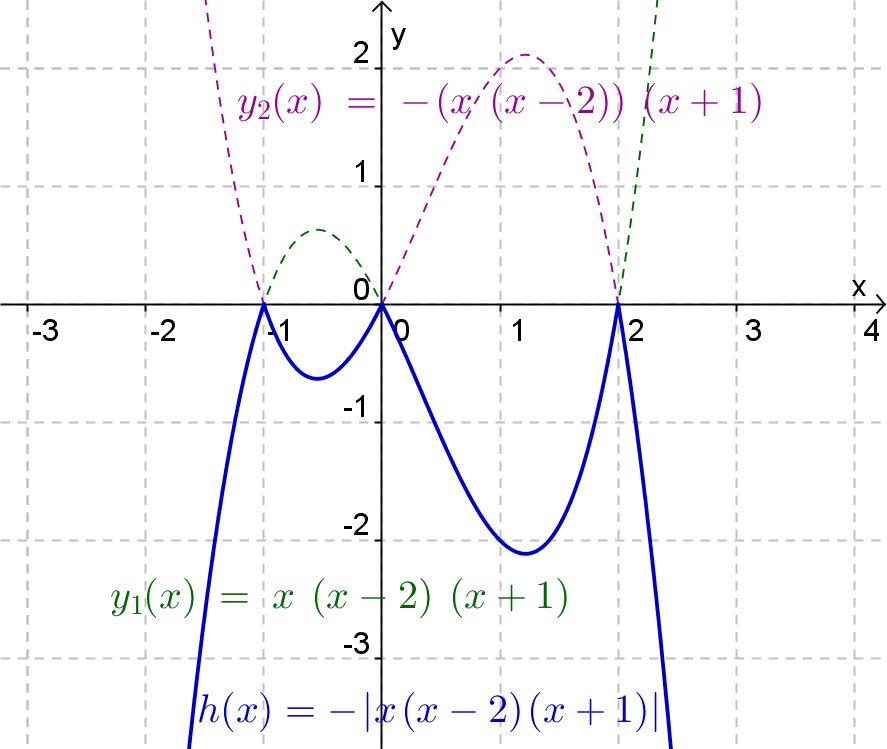
\end{array}\]Gráfico de $h$
Tendo em consideração o sinal de $y = x\left( {x – 2} \right)\left( {x + 1} \right)$, vem:
\[\begin{array}{*{20}{l}}
{h(x)}& = &{ – \left| {x\left( {x – 2} \right)\left( {x + 1} \right)} \right|} \\
{}& = &{\left\{ {\begin{array}{*{20}{l}}
{ – \left( {x\left( {x – 2} \right)\left( {x + 1} \right)} \right)}& \Leftarrow &{x \in \left[ { – 1,0} \right] \cup \left[ {2, + \infty } \right[} \\
{ – \left( { – x\left( {x – 2} \right)\left( {x + 1} \right)} \right)}& \Leftarrow &{x \in \left] { – \infty , – 1} \right[ \cup \left] {0,2} \right[}
\end{array}} \right.} \\
{}& = &{\left\{ {\begin{array}{*{20}{l}}
{ – x\left( {x – 2} \right)\left( {x + 1} \right)}& \Leftarrow &{x \in \left[ { – 1,0} \right] \cup \left[ {2, + \infty } \right[} \\
{x\left( {x – 2} \right)\left( {x + 1} \right)}& \Leftarrow &{x \in \left] { – \infty , – 1} \right[ \cup \left] {0,2} \right[}
\end{array}} \right.}
\end{array}\]Para a representação gráfica de $h$ recorreu-se aos gráficos das funções auxiliares ${y_1} = x\left( {x – 2} \right)\left( {x + 1} \right)$ e ${y_2} = – x\left( {x – 2} \right)\left( {x + 1} \right)$.