Antonio Gaudí: An Unfinished Vision
'An Unfinished Vision' does provide lots of fascinating close-ups of Gaudí's buildings and hypos interest and understanding of them
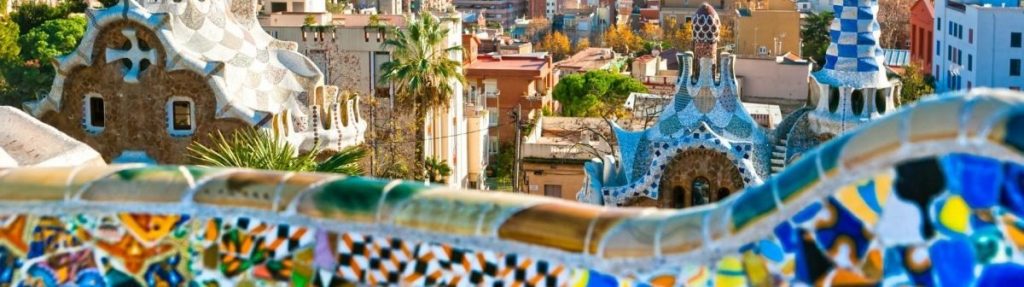
In the 1960’s, Pennsylvania-born filmmaker, John Alaimo – current Gaudí-Club member – traveled to Barcelona and fell in love with the work of Antonio Gaudí. Although his Spanish was merely “acceptable” and he had only made 6 tele-films up to that point, he was so inspired by the zany architect’s wild forms and fantastic imagination, that he decided to make a movie which documented his life and works. The film, which was written and directed by Alaimo himself, and produced by Pedro de Juan i Ballester, was an attempt to explain the concepts behind the architect’s unique style of Modernism.
The film Alaimo eventually created – “Antonio Gaudí: An Unfinished Vision” – was a 60-minute documentary, which took two weeks to film, and was set during the last 48 hours of Gaudí’s life, right up to when he was run over and killed by a tram-car in 1926. The film first aired in 1972. Originally intended for television, “An Unfinished Vision” ended up being shown at various private forums and invite-only affairs, which included the Spanish Institute’s “Salute to Spain Week” in New York in November of 1974, under the patronage of the Spanish Royal family and the honorary patronage of, among others, the then president of the United States, Gerald Ford.
The role of Gaudí, though originally intended for Fernando Rey, ended up being played by Spain’s “Man of 1000 faces”, Jose Luis Lopez Vasquez, who does a remarkably animated, yet realistic interpretation of a man who was not well-understood by many. The premise of the film is an ongoing conversation between Gaudí (Lopez Vasquez) and an eager pupil, played by José María Lana. It makes sense that the film’s storyline took this form for two reasons. First, what better way to explain the concepts of Gaudí’s work than to have “Gaudí himself” explaining his works to a student? And, second, the major part of the research carried out by Alaimo before writing the script was done based on the notes of Juan Bergos Masso – an actual pupil of Antonio Gaudí’s. Although the film’s storyline is fictional, it was only meant to aid in achieving the goal of conveying an understanding of Gaudí’s rare forms and techniques. This goal was apparently carried out with great success.
There were many factors which played into rendering this film a serious and “realistic” commentary on Gaudí’s work. First, though Gaudí would never allow students to take notes while in his immediate presence, one can assume that Bergos Masso’s notes are pretty accurate, since he was accustomed to running home and writing down every word that Gaudí had said (to the best of his ability) directly after each encounter he had with the architectural genius, while the words were still fresh in Masso’s head. Therefore, many of the words spoken by Lopez Vasquez in the film can be assumed to be words which were at one time uttered by Gaudí himself. The fact that the entire film is centered around the relationship between Gaudí and a student, and nobody else, is also quite realistic in that Gaudí, towards the end of his life, became quite a hermit, interacting seldomly with anyone besides his sculptors and pupils. The student-teacher relationship in the film is also an intimate and friendly one, whose conversations help to reveal many little-known facts about the artist and his life.
In 1973 I arrived in Barcelona, Spain to begin production of my film, Antonio Gaudi..The Unfinished Vision. While researching the script, I was introduced to an elderly person who was a student of architecture, who during his youth, knew Gaudi and had visited him many times. On those occasions Gaudi would take the student on a tour of his buildings and speak almost in a monologue, lecturing the young man about his ideas and philosophy concerning architecture and his buildings. Afterwards, when the student returned home, he would write down all he remembered of their conversation, making notes which he kept all those years. This record of the student’s notes and Gaudi’s discourse was made available to me and it was then I decided to use actors in place of narration to tell the story, recreceating as closely as possible, a visual journal of those incredible meetings. The dialogue spoken in the film and the events depicted are based on fact making the film one of the most authtentic ever produced on the life of Gaudi.
The first showing of the film occurred in the spring of 1974 when it was screened for the Barcelona media. The event was closed to the public. In May of the same year, the film was selected to be screened, out of competition, at the 1974 Cannes Film Festival in the South of France. It was reviewed in the show business publication Variety.
The final screening of the film took place in November of 1974 at the Queen Sofia Spanish Institute in New York City. It was shown as part of Salute to Spain Week, a celebration of Spanish art and culture and was by invitation only.
That was the last recorded screening of the film before it disappeared. For 35 years it was “lost”, unable to be located until 2009 when a film historian, an employee of a bank in Barcelona, discovered the film in a vault in the bank. The film has never been seen by the general public until now.
In 2009 the film received the prestigious designation of “Cultural Patrimony of Catalunya” making it an official part of Catalan culture.
John Alaimo Director/Scriptwriter
Hiperligações relacionadas: